
The headscarf was once viewed as a sign of rebellion. Western women fought for their liberation by removing confining corsets and diminishing the amount of cloth clad to their bodies in public: in short, declaring their sexuality to the masses, and inviting their approval. In clear contradistinction to the excessive glitz women are subjected to by the modern fashion, make-up and nip/tuck industry, the modern Muslim woman concealed her sexuality in public, and allowed it to flourish in private. Now, it seems a new rebellion is taking place.
Aqsa Parvez was a young, Asian-Canadian teenager was brutally murdered by her family in late 2007 for removing her headscarf ( hijab). Her death remains shocking as honour killings were previously unrelated to the headscarf, but also because it was yet more evidence to show a serious desire held by hundreds of women around the world to remove their headscarves.
I moved to Egypt in 2000, as the country was going through an ‘Islamic awakening’. Left, right and centre, I saw women donning headscarves seemingly overnight - usually after listening to a lesson by Amr Khaled - the now world famous Muslim televangelist - or someone similar. Others went much further. I remember my shock when someone I knew revolutionized her wardrobe within 24 hours; gone were the low-cut tops, the glitter-clad tight-fitting hipster jeans, and knee high red suede boots. In their place: long flowing black cloaks or abayas.
For the following nine years, I lived, worked and traveled in Africa, South-East Asia, the Middle East, Europe and North America. In the midst of my travels, I noticed a startling phenomenon in the past 3 years: the removal of the cloth, once so adorningly clung to by Muslim women world wide - what I like to call “dehijabization”.
A small piece of evidence; Facebook profile pictures of girls in hijab are increasingly replaced; sometimes, the replacement picture is as simple as a woman in loose clothes with her long, flowing hair showing, while at other times it is women posing in bikinis or mini-skirts. Women all over the world are casting off the hijab.
The question remains: Why? Why did women who spent years, or decades, in hijab decide to dehijabize? What is it that women feel must be fulfilled in life without the hijab that is apparently missing while wearing it?
I decided to ask around. Some women had originally decided to wear the hijab to counteract serious sins they had committed in the past. Ironically, some women also removed the hijab because they felt that they were sinners, and were therefore unable to live up to what they felt should symbolize a woman in a hijab. A huge number of women noted that even the most religious of Muslim men were proposing to women who were not in hijab, leaving the women in hijab feeling rather inadequate; if a religious man is uninterested in a woman in a headscarf, who will be?
Many others grew exhausted of the ‘out-of-place’ feeling they had- either because they were in a majority non-Muslim country, where the hijab was viewed as dehumanizing, or because they were in a Muslim majority country which, as a consequence of Westernisation, increasingly viewed the hijab as ‘unsophisticated’ or a sign of poor education.
Yale University anthropologist Carolyn Rouse noted the hijabization phenomenon in 2004 in her book “Engaged Surrender” as one that was about identity, rather than spirituality. Post 9-11, many women felt the need to show their solidarity and oneness with the Muslim ummah. Donning of the hijab - formerly a spiritual act - achieved that political end.
With that kind of ‘Muslim uniform’ in the 21st century comes a sad if unintentional reality - the individual Muslim woman is simply aggregated into one big, undifferentiated lump, leaving her just as objectified as the “sexually liberated” non-Muslim Western woman. Many, whether in the West or in the Muslim world, choose to give her uneasy glares and glances, while boxing her as an “oppressed woman”, who has the inability to do anything unless it is explicitly related to Islam.
The flip side of the coin is that because of the same obsession with the cloth and not its meaning, Muslims in general will demand that any Muslim woman in a hijab not simply be Muslim, but morph into an infallible angel. In this regard, the blame falls much more on the Muslim than the non-Muslim, for the Muslim should know that nowhere in the Islamic tradition is the hijab a sign of perfect character. Rather, it is the fulfillment of an Islamic duty – just like many others.
In truth, it is these Muslims who I suspect bear much of blame for the dehijabization phenomenon. There is much fear mongering instilled by many present day Muslim preachers, who have somehow made the hijab tantamount with faith itself and told to prepare for an eternity in hell if living without it. Yet, where in any of the books written by of the learned scholars of this religion is there any mentioning of the hijab as one of the kaba’ir, or major sins? A sin it may be, to be sure – but is it so dire? Perhaps it is, but the Prophets, the Messengers and the scholars of this religion emphasized it much less than other duties and responsibilities. Yet, modern day preachers will emphasize it more than they will anything else.
But this brings me to the most important point of dehijabization. Women who remove the headscarf because they choose to interpret the Islamic tradition in their own way without training; they are just as problematic as these preachers. Perhaps this is the most alarming and now widespread reason for dehijabization - women who claim that the hijab is not fard (obligatory). This was cited as the most common reason used by the majority of women I have come across who have dehijabized.
Islamic law comes down to 4 things: The Qura’n, the sunna, ijma’a (consensus), and qiyas (logical judgement). Islamic law crystallized around the interpretations of experts over many centuries: those that are now extant and most common are the 4 Sunni schools of law. For centuries, scholars have learnt Islamic law through those interpretative deductions; all these 4 schools came directly from Prophetic teachings and are upheld with their own particular interpretations all over the world. People in Egypt may not realize, but they pray in accordance to the Shafi’i madhab, while those in India follow the Hanafi interpretation of prayer.
For someone who has not dedicated their life to the study of Islam to declare that they have the same ability to interpret the Qur’an as the erstwhile amateur, comes across to me as incredibly arrogant, even while they may not realize their obvious arrogance.
Yes, there are several different interpretations, but they all must come from the basis of Islamic law. But on the hijab, there is no difference of opinion. The 31st verse of the 24th chapter of the Qur’an mentions the word khimar, which unequivocally means a veil covering the head, according to the agreed upon definition by the majority of classical commentators. The commentators ( mufasiroon) further comment by stating that the noun khimar (the singular of khumur) was a loosely worn veil which was worn long before the advent of Islam and long after.
However, during the period of the revelation, it was customary that women bared their breasts while covering their hair. In fact, as Arab men went off to battle, women used to bear their breasts to encourage them to be brave; in some cases, they would show their breasts during warfare. With the advent of Islam, until now, Muslim women have been showing only their hands and faces, in accordance with the prescriptions of the Prophet, and the passing of his prescriptions from that time until this day. That methodology is followed not just in terms of the hijab, an admittedly small piece of cloth, but in the whole of this religion.
It’s irrelevant what I, as an author, do or not do vis-à-vis the issue I write about. But on a personal note, I do happen to wear a hijab, in awareness of my duty. Like most women, I often think to myself that men should learn to control themselves, and how perhaps if they did, women would not be obliged to conceal their sexuality in public, and dress any way we would like. But in the final analysis, God has a hikma or a wisdom as to why He created men this way, and why He asked women to cover themselves - He Knows best and He is All-Knowing.
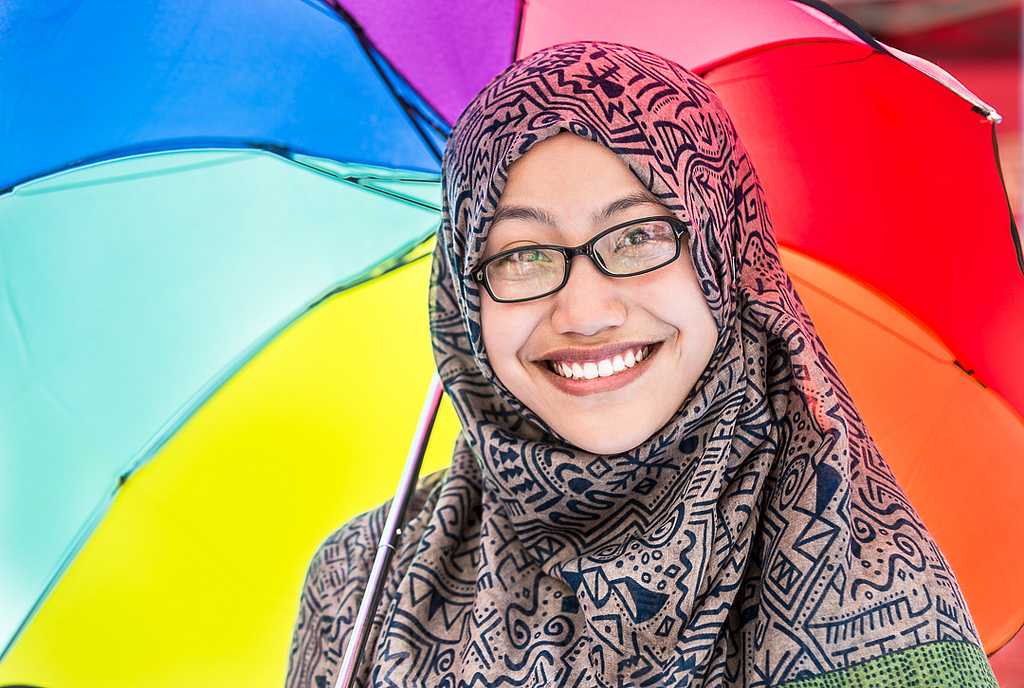
(Photo: kian1 via flickr under a Creative Commons license)Darah M. Rateb is the Managing Consultant of the Visionary Consultants Group, a Muslim world – West relations research consultancy with bases in the UK, Egypt and Malaysia
44 COMMENTS ON THIS ARTICLE
We try to remove any comments that do not conform to our netiquette guidelines. If any comments remain that are in violation, please let us know. The presence of offending comments does not necessarily reflect the views of the editors of altmuslimah.com
About 20 years ago, I saw this beautiful woman who was wearing hijab. When I found out she was a friend of a friend, I inquired about her. Less than a year later, we were married.
After a few years of personal struggle, she decided the pressure to wear hijab was too much for her. What could I do? I was already in - I loved her dearly and, besides, I couldn't force it upon her. To leave her because of it or criticize her decision was out of the question as it didn't affect her religiosity. She was just as kind, just as God-fearing, still prayed, fasted and didn't backbite (I've met plenty of hajibahs who did). As a working woman with a family, she just didn't want the added pressure in her life.
To be honest, I did feel a bit of bait-and-switch. This wasn't exactly what I signed up for, but I probably shouldn't take it personally. Yes, it still bugs me to this day, but you what? She's a great person, my very best friend, a great mother and probably the most ethical person at her workplace. If someday she decides to change her mind and wear it again, God bless her. I'll support her.
If she does, however, I probably won't say anything. It's her call. And Allah knows best.
- Posted by TarikwithaK (34.142N / -118.254W) on March 30, 2009 at 10:51 PM
I don't see a "dehijabization phenomenon" at all, rather the opposite. However those who wear it for the wrong reasons will be the ones who will most likely take it off.
TarikwithaK,
Fantastic post. We're all works in progress and inshallah those who strive to follow the best example as set by the Prophet(s.a.w.).
- Posted by DrM on March 31, 2009 at 12:01 AM
Great article! I too see a "dehijabization phenomenon" around me. Living in a Muslim country, most muslim women who take it off around here, do so to follow fashion more closely and to feel more beautiful. Even those who question if it's obligatory or not do so because they want to take it off (or not wear it in the first place) and dress more fashionably and more revealingly. I believe the reasons here are different from those living in Western countries, as in TarikwithaK's comment.
That doesn't make them bad persons, since hijab is not the first nor foremost judge of character, but it is still a "fitna". The prophet (pbuh) said that there will be a time when the person who holds on to his "deen" (religion) is as if holding on to burning coal.
My friend once observed that everyone who does take off the hijab seem to be surrounded with friends who don't mention God in their daily lives. She said, they don't have to be bad persons at all, in fact they are usually great people and have good characters but they are just not religious and there is no mention of God or religion around them. I believe that is so true, it all comes down to who are your friends and who do you surround yourself with...
- Posted by nohayo on March 31, 2009 at 07:04 AM
Good article with many nuances that I agree strongly with, including the fetishization of hijab and demanding of hijabis to be angels.
However, her closing arguments merit some discussion about the amateur interpreters. I, in fact, find that attitude arrogant: "Islam is soooo complex that only specialists who devote a lifetime of study can make decisions according with regards to Islam". She could have done better and merely said these women who deny the obligation of hijab made an incorrect choice. But, she uses this incorrect choice to deny ordinary Muslims the right to make decisions about thier own religious deeds.
Other than that, great article.
- Posted by OmarG on March 31, 2009 at 03:50 PM
Well. dehijabization. sounds like a term synonymous to nazi jewish extermination. boo.
it seems married women are more likely to wear hijab then unmarried ones. that is my experience. perhaps since they are now regimented into a narrow social order, might as well adopt the dress code.
and then there is the idea of wearing hijab in a society where most women walk around in their underwear. surely wearing hijab would classify as extremism? its like showing up wearing a niqab in a church service. relative extremism.
horny muslim men going after hijab-less chics instead of hijabis may have more to do with dealing with oppressive family members involved in bagging the chic. there is a subtle inference that the top-less (relatively speaking) model will make her own decisions and the bottle top model (no pun intended) will require haggling with parents.
ibn jundul in his classic work al-maqasid fi al-ghazawat el-hurain informs us that 'baring their breasts' was actually a form of psychological warfare against the enemy. to show them up, "hey look this is booty you are not going to be getting boo hoo"(all puns unintentional).
- Posted by Greybeard (Canada) on April 1, 2009 at 12:07 AM
oh crap. its April Fools Day. and i get to post first. shoot.
- Posted by Greybeard (Canada) on April 1, 2009 at 12:09 AM
>>>> The question remains: Why? Why did women who spent years, or decades, in hijab decide to dehijabize? What is it that women feel must be fulfilled in life without the hijab that is apparently missing while wearing it?
Wrong question! What do women feel when wearing the hijaab that they don't feel when they aren't? It might be unpopular to say, but its more likely that hijaab is being just as easily discarded to get rid of negative social identity labels rather than just to assert some positive notions of identity.
The fact is that women who are liberated sometimes cover their hair to take ownership of their Islamic identity, and sometimes discard head covering to take ownership of their Islamic identity. Sometimes its neither. Whether with a head covering or without a headscarf, women want to define their own identity and not have their identities imposed on them for whatever social cause, dogmatic understanding, honour bound notions or publically acceptable displays of loyalty to religion.
Muslim societies around the world (whether our sisters are in hijaab or not in hijaab) have taken to sexualising feminine identity and undermining feminine intellect, creativity and independence. Moralistic judgements and social punishments are imposed when behaviour is deemed "unacceptable" (judged generally on appearance). I find as many women who are covering themselves fully are as inclined to accept their status as human beings as being primarily defined by their sexual nature, as those women who don't.
Whether this is a direct result of our increasing failure to cultivate taqwa or because of a pervasive commercialisation of values etc .. it's hardly the problem of good girls gone bad in my community (or bad girls gone good if they're wearing scarfs). The ayats may be clear to the author but what happens to those women who find the head scarf is an imposition on their freedom of choice and freedom of expression? She should know that those same interpretations using the "basic of Islamic Law" and those same commentators don't find her freedom to work/consult outside physical compulsions of hunger and destitution too permissible either.
Its very hard for me to read the nuances in this article when all it's really doing is using anecdotal evidence about peoples intentions and the nature of modesty from some facebook interludes. There is no in-between in her article. Women are either in bikinis or in hijaab. They are either abandoning their duty or complying with it. Where are the women who are doing neither? Not enticing anyone, not discarding duty or modesty, not rushing off into some new fervently dogmatic identity role? What if the presence/absence of scarf has nothing to do with our imposition of its "meaning" or even any interrogation of Islamic/western literature?
>>> In this regard, the blame falls much more on the Muslim than the non-Muslim, for the Muslim should know that nowhere in the Islamic tradition is the hijab a sign of perfect character. Rather, it is the fulfillment of an Islamic duty – just like many others.
Duties to our Creator cannot be imposed by others. Duties to fellow human beings, must as a necessity be imposed. Unfortunately, the reverse is true of the communities general understanding of Islamic tradition.
- Posted by Ghulam (South Africa) on April 1, 2009 at 10:07 AM
SHAKIR: And say to the believing women that they cast down their looks and guard their private parts and do not display their ornaments except what appears thereof, and let them wear their head-coverings over their bosoms, and not display their ornaments except to their husbands or their fathers, or the fathers of their husbands, or their sons, or the sons of their husbands, or their brothers, or their brothers' sons, or their sisters' sons, or their women, or those whom their right hands possess, or the male servants not having need (of women), or the children who have not attained knowledge of what is hidden of women; and let them not strike their feet so that what they hide of their ornaments may be known; and turn to Allah all of you, O believers! so that you may be successful.
>>> God has a hikma or a wisdom as to why He created men this way, and why He asked women to cover themselves
I have a real problem when people start reaching such far reaching conclusions about the nature of people or the nature or nature or the nature of Allah SWT. Allah SWT also expects men to cover themselves. Allah SWT also created women "that way". It is not wisdom to misrepresent/moralise the truth.
I think there are many historically inaccurate assertions in this article regarding hijaab. Wearing a veil on the head is not the same as covering a person up in straitjacket. The khimr may and may not have been the general case before revelation. I also think that the Quraanic ayat is being given a very shallow background. Why is it that women are being asked to lower their gaze if Allah SWT created that sexual vice/capacity in mens natures only? Whether mufasiroon assert otherwise, the verse is about covering breasts, because ... that's what the ayat says. You cannot draw your pants over your ornaments or your shirt over your ornaments (because they'd already be covered). Also, The head covering is meaningless if modesty is absent. And modesty is definitely present in many women who do not cover their head, yet many women who do may be indeed be very immodest.
And like all these issues, the very real problem of sexuality and the modesty of men is being shrugged off as the side issue, yet subtely promotes that miseducation.
- Posted by Ghulam (South Africa) on April 1, 2009 at 10:10 AM
I think there is a crucial distinction here that I've observed from anecdotal evidence: when women *chose* to wear hijab, its often because they want to be known as a Muslim (seems quite in line with the ayah that says, "so they will be recognized [as spiritual women] and not bothered"). However, when women are *told* to wear it, the reasons given usually have to do with protecting mens' sexuality.
So, the scarf itself as a cloth means nothing; like everything in Islam, the intention behind it means everything.
- Posted by OmarG on April 1, 2009 at 10:36 AM
Just an observation -- In my 20+ years of corporate life in America, I've met many Muslim women professionals, but cannot recall one in hijab. Most Muslim working hijabi (sp?) women I know work in academia or medicine.
- Posted by TarikwithaK (34.142N / -118.254W) on April 1, 2009 at 11:37 AM
@Tarikwithak,
I worked for a business school and I think the reason you see few women in hijab in the business world is because of the way business schools groom their students. I have attended several functions where business students are taught how to dress, how to eat, how to speak etc. I noted that a hijabi would have a difficult time trying to land a position in the business world simply based on her form of dress.
BTW, I think hijabis have also found our/their place in the non-profit world and government. I am a rare bird in that I work in the Adult Corrections field.
- Posted by Samah (USA) on April 1, 2009 at 01:16 PM
the reason why you do not find hijabism in the corporate world is because CORPORATISM is a religion in its own right. if you ever reflect on it,
- it has its own Gods (Pay, Retriement Package, Benefits) that take care of all your worldly and 'spiritual' needs.
- its own Prophets (Bill Gates, Warren Buffet, and on down)
- its own mosques (with washrooms and all and more parking space too)
- its own dress code
- its own priests (human resource personnel)
- its own books of ethics (kept by the priests like the Bible used to)
and on and on and on.
- Posted by Greybeard (Canada) on April 1, 2009 at 02:33 PM
@ OmarG, it's not what I understand from the article. It's a fact; such "interpreters" do exist. Take Gamal El-Banna as one example. He's caused this "fitna" to many women.
@ TarikwithaK, I think your duty is 1- to keep praying for her 2- to remind yourself and her that you're unhappy with how she walks out; Keep reminding her you would love to go out with her but are less likely to do so because you don't want to encourage other guys see her and 3- to try to surround her with good Muslim friends who will remind her.
@DrM I do agree those who wear it for the wrong reasons are - most of the time - the ones who take it off: like a girl wanting to marry a religious guy. That practicing Muslim guys who seem to be religious sometimes marry uncovered and sometimes too underdressed women, is a test to Muslims for their intetions, both men and women.
May Allah guide us all, thanks Darah for this important article. Somebody should write about it other than cheering secularists.
- Posted by Duha on April 1, 2009 at 03:06 PM
Well, I like Tarik's response pretty well. He disagrees but sees his wife's religiosity not diminished. He has not reduced his wife to merely a scarf-wearer to uphold an abstract identity but continues to see her as a human being who performs concrete good deeds.
>>to keep praying for her
Good suggestion.
>>but are less likely to do so because you don't want to encourage other guys see her
That's a terrible idea. Its a sure road to making her feel unaccepted and is emotional coercion for which Islam tells us a person is not rewarded for, since actions are only by intentions to do something for Allah, not to please another person. I would say that this would be introducing fitna into someone else's marriage.
>>May Allah guide us all,
I think he has already guided Tarik to an outstanding behavior that exemplifies the best of ou Islamic traditions.
- Posted by OmarG on April 1, 2009 at 04:25 PM
taking off hijab due to "social pressure at work" is an interesting phenomenon. what next? if the company steals and lies and cheats to make a profit. will she (or any muslim for that matter) overlook that next as just something "related to work" and as such distinct from "Islam at home"??
so it would be OK to work say as an accountant for Lotto 687. its work, its against your islamic principles. but. its either that or stay home. or worse flip burgers for minimum wage.
life is of course not black and white, but shades of grey. interesting how people choose the shades when encountered head-on with secular society.
- Posted by Greybeard (Canada) on April 1, 2009 at 05:04 PM
>>>> BTW, I think hijabis have also found our/their place in the non-profit world and government. I am a rare bird in that I work in the Adult Corrections field.
I think that you don't find many women with hijaab in the corporate sector, because it is unlike medicine or other academic oriented fields. Corporate is a more accessible environment to people with less money and is innately dependent on fostering good workiing mutual relationships between people. It is open to more working class people and is more likely to attract people who would never have had opportunities to become professional in other socio-economic circumstances.
A masters level degree is more likely accessible to "old money" than it is to the new entrepreneurial environment. I personally know of quite a few traditional and non-traditional sisters in the corporate sector. But I've found that those sisters who want the options of flexible working conditions and and have the money are pushed into more "appropriate" fields of education.
If any of the more traditional family backgrounds are anything like mine, the distinction between those wealthy trading immigrants and those working immigrants has translated into different approaches to tradition and religion. Traders from India had more close-knit traditional family backgrounds and conservative approaches to women working, while artisans (barbers and tailors) were less likely to fall within that mindset and more likely to integrate in the surrounding culture.
Yet again, we are making the mistake of aligning the scarf with the Islamic value system, whilst how we relate to people or treat civic duty are just as much of a reflection too! I don't think sisters take the scarf off to please their colleagues, many were not wearing the scarf in the first place and those that were wearing the scarf may have been held to being housewives or marrying early. In many traditional families, an educated daughter is more likely to be married to someone more affluent.
- Posted by Ghulam (South Africa) on April 2, 2009 at 05:41 AM
I doubt there is any disagreement that neglecting concrete obligations that are commanded of us in the quran is a sinful act.
I believe most people who consider this issue to be one that is quiet likely that of a major sin is because Imam al-Ghazzali (and many other major ulema) have advised us that repetition of or persistance in a minor sin has the effect of it becoming a major sin.
People would prefer that this wasnt true of women not wearing hijab, but there isnt one rule for persistance in the sin of not wearing hijab and another rule for all the other minor sins.
Truly there is a need and desire for a certain amount of private space for greater freedom of movement and actions have a context. Not everything needs to be transparent.
I don't see a phenomenon of dehijabization but some women choose to take it off, or to never wear it in the first place, while others stick by it. I am aware of different interpretations and try to tolerate them. I even look at the glitz of women in Hollywood and try to learn from how they maintain themselves.
- Posted by Saadia on April 6, 2009 at 11:41 PM
But I agree that some women in hijab look beautiful, and with conscious effort towards their clothes and skin. After all, knowing that everyone is watching all the time, some feel, 'I better not be too frumpy. I'll show them I'm not square.' Some people even look better with it on and their makeup nicely compliments the fabric on the hijab.
"in short, declaring their sexuality to the masses, and inviting their approval. In clear contradistinction to the excessive glitz women are subjected to by the modern fashion, make-up and nip/tuck industry, the modern Muslim woman concealed her sexuality in public, and allowed it to flourish in private. Now, it seems a new rebellion is taking place."
I disagree that just because someone doesn't wear hijab they are subjecting themselves to the nip/tuck mentality of having to change and be something they are not. After all, if that feeling of insecurity does exist, it can exist in privacy, as most people watch TV ads anyways.
- Posted by Saadia on April 6, 2009 at 11:49 PM
"The question remains: Why? Why did women who spent years, or decades, in hijab decide to dehijabize? What is it that women feel must be fulfilled in life without the hijab that is apparently missing while wearing it?"
Personally I just took off the hijab because it felt impractical and unnecessary after a point.
I wanted to play sports again, I wanted to be able to go swimming without having to care who was watching, I wanted to be able to enjoy the breeze on my neck. I was questioning the practicality of having a fixed dress code for all times and places. After all, I thought, it made perfect sense to want to wear khaki shorts if I ever went on a safari in Kenya or something.
Also I felt that the hijab was just creating a false sense of security in me.
(Bear in mind that I'm at best a cultural Muslim at this point ... I don't practice Islam anymore.)
ADD YOUR COMMENT
Commenting is not available in this weblog entry.
|