
Once upon a time, Fareed, a tall, dark, and handsome duke of Bangladeshi descent, and Laila, a fair damsel of Eastern European Circassian blood, decided to get married. Having finally found life partners in one another, they embodied all the metaphors and symbols that stand for wedded bliss: white doves, harps and violins, red roses, and a pumpkin that not only turned into a carriage, but remained one even after the stroke of midnight
Once upon a time, Fareed, a tall, dark, and handsome duke of Bangladeshi descent, and Laila, a fair damsel of Eastern European Circassian blood, decided to get married. Having finally found life partners in one another, they embodied all the metaphors and symbols that stand for wedded bliss: white doves, harps and violins, red roses, and a pumpkin that not only turned into a carriage, but remained one even after the stroke of midnight.
But alas, their happily ever was still not to come, for lo and behold, there stood before them an obstacle of great magnitude: their families accepting their racial differences.
It took a lot of strength and courage for them to convince their families that their racial backgrounds were not hindrances, but keys to fulfilling, exciting lives. They shared the same morals and values- and that was enough for them. Many moons later, the family accepted and gave their blessings.
And after that, the couple lived….happily ever after…
There was indeed once a time when such stories were called fairy tales, where the marriage of interracial couples was shelved under “fiction” and “fantasy,” and maybe even “sci-fiction.” But with time, and changing social values in a country juggling millions of people and millions of beliefs, the acceptance of interracial marriage has started to take its own place on the shelf.
According to a new study by the Pew Research Center, an analysis called “Marrying Out” has found that one in seven new marriages in the U.S. is interracial or interethnic (according to U.S. Census Bureau Statistics.)
As far as the breakdown of categories, the report states the following:
“Of the 3.8 million adults who married in 2008, 9% of whites, 16% of blacks, 26% of Hispanics and 31% of Asians married someone whose race or ethnicity was different from their own.”
Giving another perspective, a recent New York Times article, “Black Women See Fewer Black Men at the Alters” discusses the continuously shrinking pool of black men as potential spouses for black women. While this is a recent Pew finding, it is interesting to note the comments below this article that indicate sheer frustration with what is actually a long and historic discourse about the lack of eligible black men, and the forced label of “cat lady” upon black women who are deemed to have hopeless futures without black men as husbands.
The report speaks to a metaphorical marriage of the United States with a new colored identity- the first Black President, the first Latin American Supreme Court Justice Sonia Sotomayor, and at the pop culture end, Aziz Ansari, the first South Asian to host the MTV Movie awards.
It is interesting to note that Muslims cover the cross-section of races that make up the record high of interracial marriages. The report states that 31 percent of Asians married someone outside of their race. (Quick overview: Asia has over 50 countries). That means that those who identify themselves as Asian can be from anywhere from China and the Philippines to Saudi Arabia and Turkey- areas where you can find the highest concentration of Muslims.
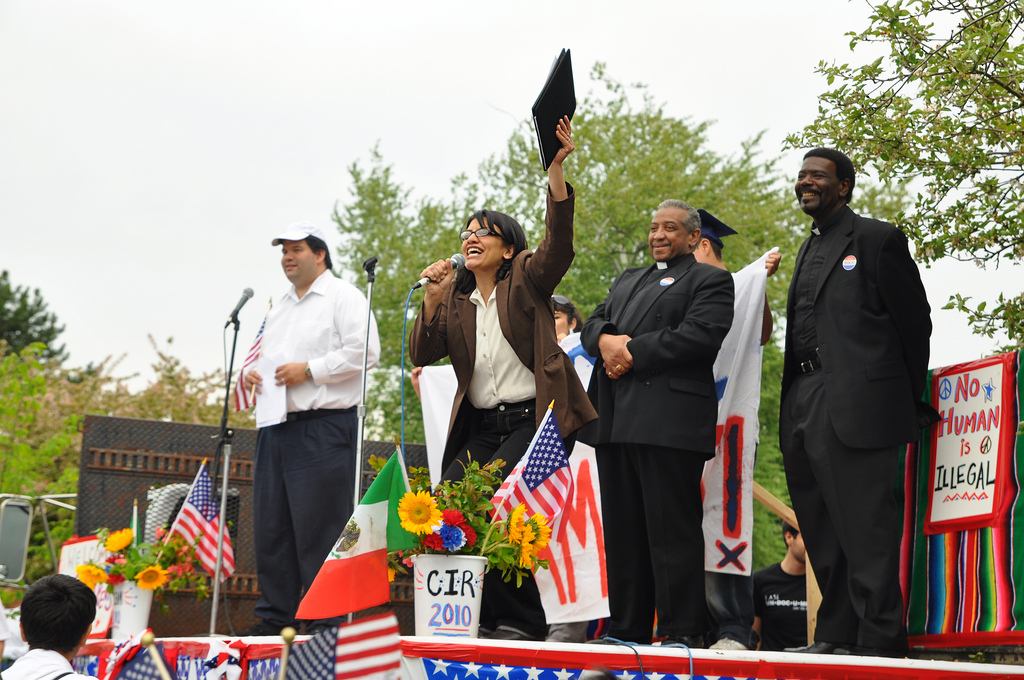
We have come a long way from interracial marriages being outlawed in this country, but even those groups that have been reported as having the highest rate of “outside” marriages have pockets that still look down upon interracial marriage.
How do Muslims feel about this news? Theoretically, you can find the majority applauding the study, aligning it with Islam’s celebration of diversity and breaking down class and racial barriers; but practically speaking, there are many parts of the Muslim community that hold racial biases, and interracial marriage still remains a taboo across the Muslim world.
You have the usual reasons: language differences, cultural differences, food differences (we are very sensitive about food), and then the expectation that there is an inability to adopt, assume, or blend those differences. Then there are the surface reasons: light skin color versus dark skin color, fragile frames versus heavy-set frames, hair loss rate, hair-graying rate, and height patterns across various ethnic groups. Some of these cultural stereotypes are kept in mind when spouse-shopping.
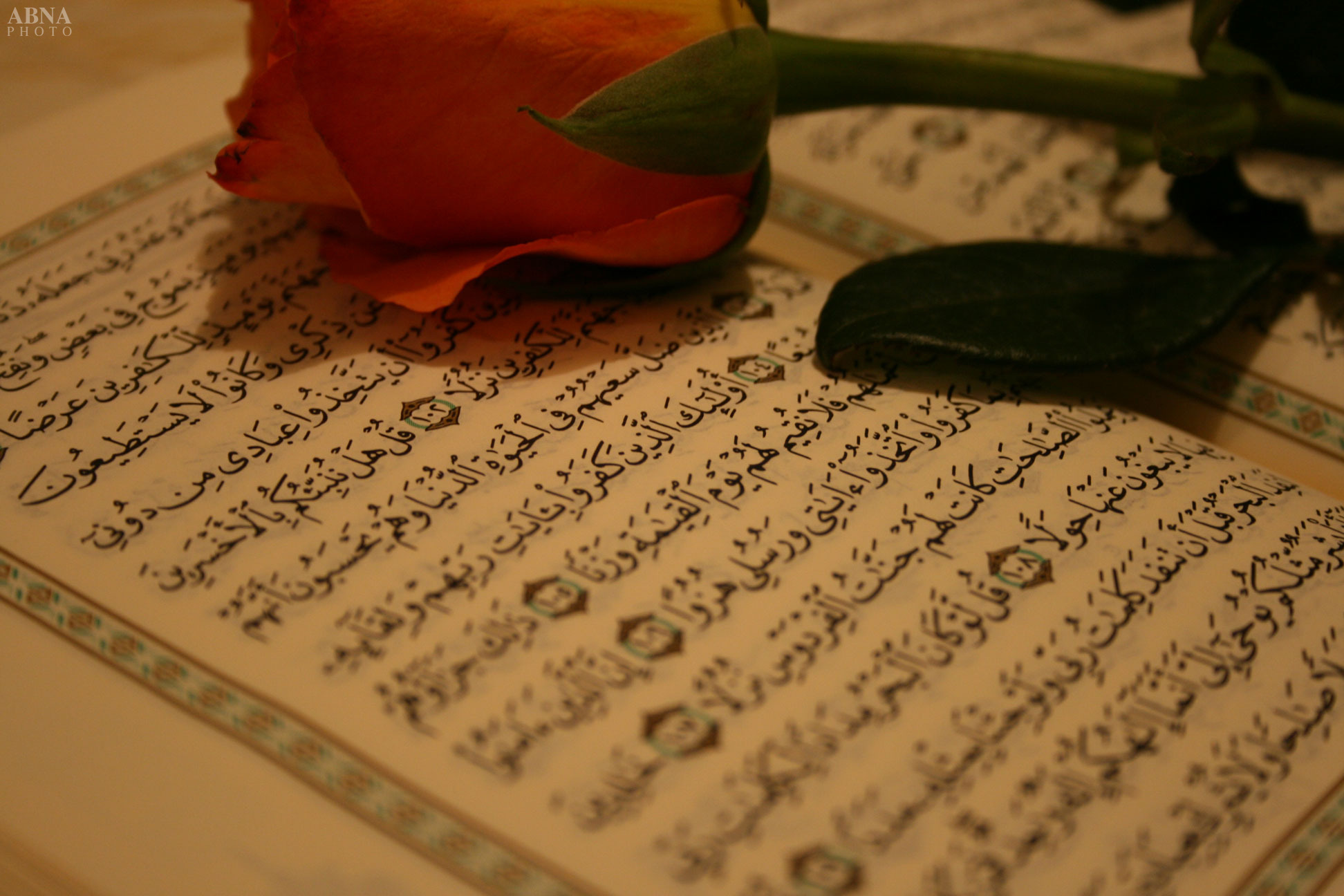
Given this, it is time to tell the Muslim interracial marriage narrative as well, to celebrate it, embrace it, and chronicle it, keeping in mind the Quranic verse:
“O mankind! Lo! We have created you male and female, and have made you nations and tribes that ye may know one another. Lo! The noblest of you, in the sight of Allah, is the best in conduct. Lo! Allah is Knower, Aware.” (49:13).
While it’s nice to see the data on how exactly the human race is progressing on the tolerance and acceptance scale, it is also nonsensical that in 2010, we are still concerned and amused by interracial marriage and the fact that not only can people of other races get along, but that they can actually get married too!
Shazia Kamal is a community activist in interested in social justice issues living in Los Angeles, CA

great article! it is so true that we put our own limits on ourselves and then we wonder why things aren’t workign out exactly as we wanted them… I am the first to admit that “happily ever after” is far from the reality, and that interracial marriages often DO have more potential sticking points, but they are not impossible and nt even always difficult—esp if both are of a shared religion.
Btw, Shazia, I lol’d at this: ”(we are very sensitive about food)” ! like it was a big hush-hush secret… 😉
I almost threw up in my mouth after reading the first sentence in this article. In the eyes of another circassian, she is no longer one. And I doubt this girl was from “circassian” descent or her parents would have known better. It’s also possible her father is weak and accepted this because he did not raise her correctly.
Great points.. except inter-ethnic or inter racial marriages were “sci-fi” only in Western/American context. In Muslim context interracial and inter-ethnic marriages were widely practiced. For instance,who do you think in Ottoman empire all those Turkic soldiers and Pashas were marring while conquering Europe? What ethnic origin was Roxolana, the wife of one of the greatest Ottoman Sultan’s? Why Russian ambassador to Persia Griboyedov was murdered? (Because he self righteously raged a riot to “liberate” all of Armenian and Georgian descent women from their “oppressive Muslim/Persian” husbands. And there are thousands if not millions of evidences of such marriages all over Muslim world. In fact, preference and limitation for exclusively our own cultural background is an innovation of the 20th century. Nationalism as well as ethnicity rarely played any role in choice of a mate among Muslims. Now tribalism (like for instance Circassians, Pashtuns, etc.)is a different question, and has to be addressed separately, but ethnicities that were not tribally organized rarely had that issue. I’m sure very happy my culture has grown out of the whole tribal period, otherwise my life would be extremely complicated in this world and would most definitely harm my “inter-ethnic” marriage.
Great article, the struggles and obstacles of finding a spouse are hard enough and then being limited by race and culture can drive ppl insane. if it was my way we all wud be one big mixed race lol. seriously dont mess wit the food lol jk
It isn’t easy. Often we have difficulty accepting ourselves vis a vis our own cultures. Plus the young generations are faced with real challenges around emotional literacy.
I am offering co-therapy for multicultural couples in Berkeley, CA along with Rulik Perla – the website is http://multiculturalcouples.com .
My origins are Pakistani/Muslim, Rulik’s are Israeli/Jewish. Learning to communicate and love one another more skillfully should be near the top of our priorities lists.
Inter ethnic marriages will be *THE* glue that cements our multi-ethnic communities in the West.
???circassian???: there is a fine line between ethnic pride and racism, which your comments suggest you have crossed. Please, find some land where all ???circassians??? can live all by themselves and not depend on the smarts, protection, and money of us non-???circassians???. May Allah put low those whose pride is based on their origins or ethnicity, as he has promised to do.
This is a touchy subject and no on will ever agree with one another, history will repeat itself.
Auto Warranty
Extended Warranty